around the house / #3658-60 ~ cleaning up

(embiggenable) • iPhone

(embiggenable) • iPhone

(embiggenable) • iPhone

A FEW DAYS BACK, I STARTED WRITING AN ENTRY that addressed Stephen McAteer's question:

"...do you have any posts outlining how you get such natural colours in your pictures?...My own photographs tend to be over-saturated as they come out of the camera. I would much rather have naturalistsic colour rendition like yours."

However, as I was plugging along on it, I realized that I was writing a long-winded how-to tutorial of how I get to my color look. A process which is very dependent upon my very specific workflow and tools that may or may not have any relevance to anyone else. So, what follows is more of an overview which I hope will be more helpful.

Let's start with a few lines form Paul Simon's song Kodachrome:

They give us those nice bright colors
They give us the greens of summers
Makes you think all the world's a sunny day, oh yeah

Back in the good ol' days of film, picture makers had lots of color film choices. And each one of those choices came a film makers' idea of what color should look like, even to the point where individual film makers had multiple color film offering, each with a different idea of how color should look. Not to mention the difference between how transparency film and color negative film dealt with color.

My choice in the analog era-for my personal picture making-was always a Kodak color negative film which was biased toward "natural" or "neutral" color rendition. That's cuz I wanted my pictures to represent, as close as the medium could produce, color that looked like what my eyes perceived in the real world. The fact that color negative film also delivered, compared to transparency film, a greater dynamic range-with wonderful soft highlight rendition-was an added bonus.

In any event, the look I obtained from using a neutral / natural color negative film became the look I came to, dare I write, love. And, it is also the look that I strive to achieve in my digital era picture making. I think of it as my embedded-in-my-head/eye baseline.

Moving on ... the key to obtaining natural color is to first identify the color "bias" of the picture making device you use. There are probably a number of techincal means-involving expensive equipment and software mastery-of doing so. Then there is the non-technical seat-of-your-pants manner of doing so which only involves your eyes and some messing round with Photoshop and a reasonably calibrated monitor.

HINT: most picture making device makers create color engines which tend to be biased toward a warmish color rendition with a bit of color saturation thrown into the mix, i.e. warm(ish) "rich" color. Hey, why not, cuz who does not like the world to have "nice bright colors" and look like all that world is "a sunny day"? Based on that observation, I find that I do most of my color "correction"-in pursit of natural-like color-in the yellow and red color channels.

In my specific picture making world, I have found that I need a just a bit more adjustment (reduction) in the Y segment of the B channel than in the A channel (also a reduction). Although, in some images, I find I only need to make the B channel adjustment. In making just these 2 relatively minor adjustments, it is amazing how natural-like all of the color in an image becomes.

In it also important to note that ALL processing for contrast / tonal adjustments be made on the LIGHTNESS channel in LAB color space. Making those adjustments on the RGB curve line will effect the color in an image as well. Not so with the LIGHTNESS channel.

Once again, I should point out that my color processing is performed with Photoshop using, almost exclusively, the CURVES tool in conjunction with the INFO window. That processing is always performed on individual color channels, NEVER on the RGB curve line. And, my normal processing adjustments are usually made on the A and B channel in LAB Color Space. NOTE: I never use the Hue/Saturation tool over than, after mking my color adjustments, I will now and again use the tool to reduce overall saturation by just a smidge.

The one adjustment function for which I do use RGB color space is the first adjustment I make-if I deem it needed-on an image. Step 1 is to identify the highest value (closest to 250 in the INFO window) hightlight in an image, one that I want to appear as a clean neutral white. Then on each individual color channel, I adjust each channel to be equal (as seen in the INFO window), as in 250R / 250G / 250B. Then, step 2, keeping the same CURVES window open, I find the lowest value shadow (closest to 10) that I want to appear as a clean neutral black, then I adjust each channel to be equal (as seen in the INFO window), as in 10R / 10G / 10B.

At this point, the CURVE line shoud still be a straight line. If that is so, just by adjusting the highest and lowest color values to equal, as incredible as it might seem, all of the color values along the CURVE line will be as "clean" as they can be, given the overall color bias of a devices' color engine. It is at this point, I move on to making my correct-the-devices-color-bias adjustments (R and Y) in LAB color space.

As mentioned, all of this image processing is based on the use of the CURVES tool + INFO window in Photoshop or some other processing software which has a CURVES tool and allows for processing in LAB color space. Using CURVES may seem like rocket science to some but, if so, there are a zillion simple tutorials out there that do a good a job of demonstrating the use thereof.

That's it folks. Hope this was helpful.

landscape / around the house # 3652-54 ~ waiting for rain

in Nova Scotia ~ (embiggenable) • µ4/3rd

(embiggenable) • iPhone

(embiggenable) • iPhone

INCREASINGLY I FIND MYSELF BEING DRAWN TO MAKING pictures which are without any apparent center of attention / featured referent. Which, by extension, would seem to suggest that those pictures have no particular meaning or considered intent. That, quite simply, they are, just pictures.

However, don't be fooled. I am making these pictures with a very well considered intent to convey a concept, or, if you will, a "meaning". And, be advised that my head is working at explaining the intent / meaning-without having to delve into arcane / obtuse artspeak gibberish-of the concept driving this work.

More to come.

around the house (and the hospital) / # 3650-51 ~ seemingly crazy stuff

me and part of the team + the “umbrella” that’s now inside my heart~ (embiggenable) • iPhone

(embiggenable) • iPhone

BACK HOME WITH AN "UMBRELLA" IN MY HEART AFTER MY 24 HOUR VISIT TO Vermont. All is right with the world...or...actually, not with the world but rather with my world. My WATCHMAN procedure was successful. At this point, it is 5 days of no squatting, lifting and minimal stairs in order to allow the small incision in my groin to heal and then it's on with the show.

In the interim, I am working on an entry in reply to Stephen McAteer's request:

"...do you have any posts outlining how you get such natural colours in your pictures?...My own photographs tend to be over-saturated as they come out of the camera. I would much rather have naturalistsic colour rendition like yours."

Don't know if that entry will be my next entry but it will be appearing soon.

FYI, re: the hospital picture, while the lead doctor is making a selfie-at my request with my iPhone-of himself and me, the anesthesiologist next to me is putting a temporary monitor into the artery in my wrist.

rain / the light / # 3642-45 ~ image and Doppler evaluation

(embiggenable) • iPhone

(embiggenable) • iPhone

(embiggenable) • iPhone

the umbrella

the umbrella

YESTERDAY I SPENT THE DAY HAVING A transesophageal echocardiogram. This is a procedure in which an imaging device was put down my esophagus in order to obtain a close / detailed view of my heart. In my case, this procedure was performed to determine that: 1.) the blood clot found in my heart last December had dissolved, and, 2.) confirm that my heart was a good canidate for the Watchman procedure. I passed on both counts. So, next Monday, I do the Watchman thing wherein they put an "umbrella" in my heart.

Moving on to other recent news, this past Saturday evening we experienced a somewhat uncommon manifestation of what we have dubbed, Hobbit Light. Hobbit Light is an atmospheric condition which causes the landscape to be bathed in intensely yellow-red light. The very air itself seems to be yellow-red.

In most cases, Hobbit Light lasts about 15-20 minutes and happens at sunset, with a heavy cloud cover, and following a heavy rain. It is most intense after the sun has set, during the time known as the gloaming or, as I like to call it, entre chien et loup (between the dog and the wolf).

iMo, there are 2 characteristics of Hobbit Light which make it rather eerie: 1.) there is no directional light which results in a flat / soft, almost shadow-less, "murky" light, and, 2.) every time I have experienced it, the air is as still as a statue which creates a very quiet / still landscape.

Taken together, that creates a very other-worldly feeling. Kinda like Middle Earth.

flora / kitchen life / # 3627-28 ~ whistle while you work

(embiggenable) • iPhone

(embiggenable) • iPhone

THE PHRASE "WORK HARD", re: MAKING PICTURES, SEEMS TO ME TO be a rather ridiculous misnomer when mentioned / written in that context. However, that is exactly how it is being used in a 3-part entry on T.O.P.

Let me begin on this topic with one of my favorite quotes from Bill Jay ....

"...photographers who carry 60 pounds of equipment up a hill to photograph a view are not suffering enough, although their whining causes enough suffering among their listeners. No, if they really expect us to respect their search for enlightenment and artistic expression, in [the] future they will drag the equipment up the hill by their genitals and take the view with a tripod leg stuck through their foot."

Now, to be fair, Mike Johnston does begin his series with writing that "no one cares how hard you worked", to which I would add, that is cuz it is all about the pictures you make, stupid. However, my point, re: working hard while making a picture, is that, if one is working hard at it, then that's cuz: a) he/she does not have their own unique vision, and/ or, b) he/she does not have a firm, yet relaxed, grip on the mechanics / technicals of making a picture.

Re: a) he/she does not have their own unique vision - assuming that one understands the concept of vision as knowing how one sees, literally and figuratively, the world and how that knowledge is the basis upon which you make pictures, then making pictures is as easy as just about anything gets. That's cuz, all you are doing is making pictures of what you see.

You only have to work hard when making pictures when you are making pictures of what you have been told is a "good" picture. As in, picturing a "good" referent using "proper" techniques. Or, in other words, when you are working to someone else's standards rather than your own. To which I write, "Screw that."

Re: he/she does not have a firm, yet relaxed, grip on the mechanics / technicals of making a picture - if you are "hauling around 60 pounds of equipment", you are burdening yourself, literally and figuratively, with too much crap which will only get in the way of picturing what you see. If you understand and have idenitified your own unique vision and use that knowledge as the basis upon which you make pictures, then it should be understood that, at this point, you should have narrowed your equipment list down to 1 camera / 1 lens.

Essentially, what that-1 camera / 1 lens-means is that for every unique vision there is a single unique lens. Really. Trust me-and the overwhelming majority of unique-vision driven pictures makers-on this one. It is as simple as that when it comes to making it easy, no working hard required, when making pictures. Or, in other words, when the picture making device in your hands becomes invisible, no thinking required, then all of your other senses can be focused upon the seeing.

All of that witten, I have never, in my picture making life (personal and professional), associated the phrase "working hard" with picture making. Applying my efforts with diligence, focus and determination? Sure. However, that written, the phrase I associate with my picture making is "having fun".

Or, in other words, it's never "working hard" when you are whistling while you work.

around the house / flora / # 3624-26 ~ the cruel radiance of what is

no wonder the wife likes working from home ~ (embiggenable) • iPhone

(embiggenable) • iPhone

(embiggenable) • iPhone

THIS ENTRY MIGHT JUST BE AN EXERCISE in futility for some inasmuch as, if the included link is behind a pay-wall, my point will be somewhat incomplete. Nevertheless ....

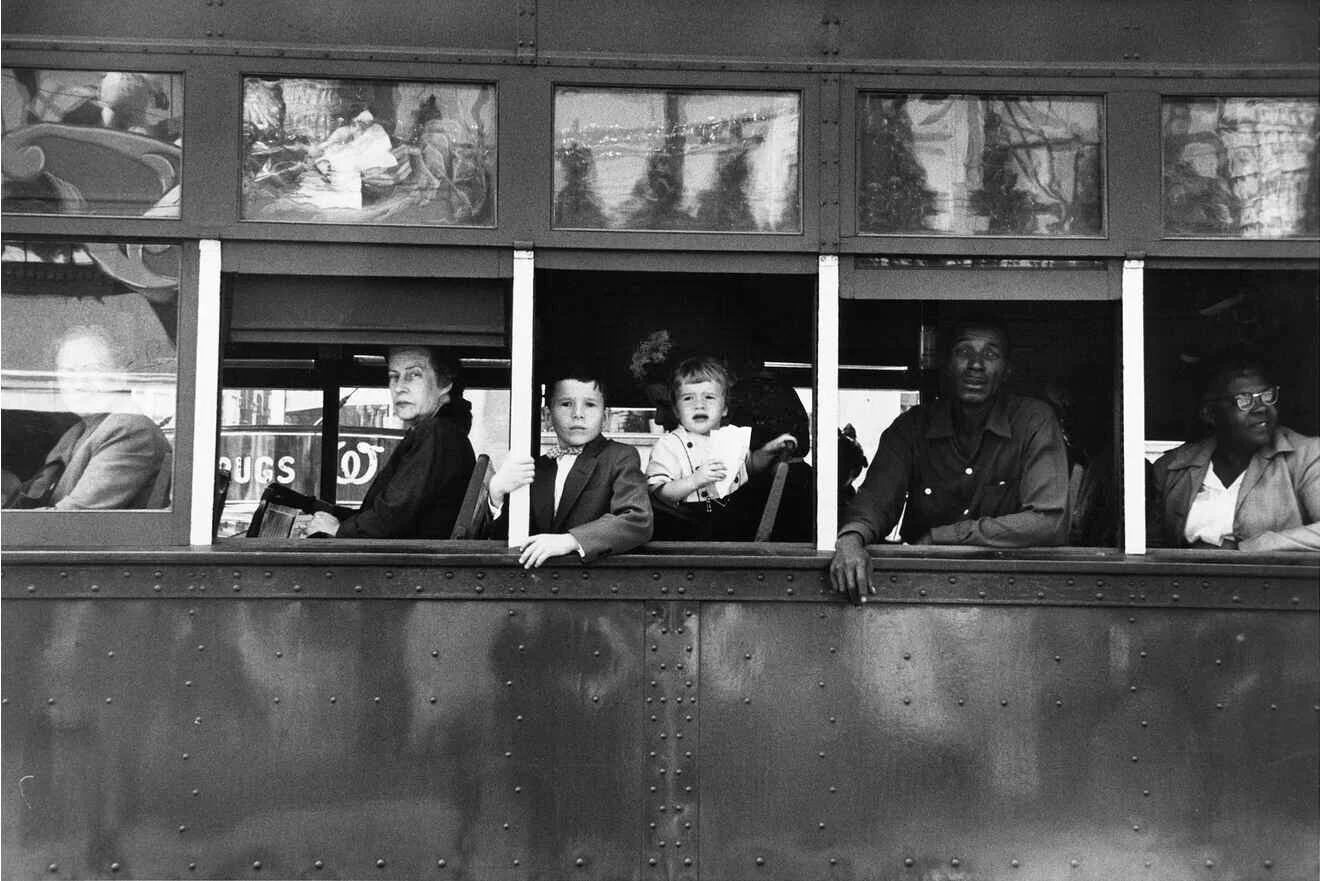
... here is the link, A PORTRAIT IF AMERICA THAT STILL HAUNTS, DECADES LATER. In case you can not link to it, it is an article about Robert Frank's New Orleans Trolley picture.

neworleanstrolleyfrank.jpg

The article itself is a dissection, one might even write vivisection, of Frank's iconic-at least so in photography circles-photograph from his landmark work/book, The Americans. The author of the piece is Arthur Lubow, a journalist who writes mainly about culture and is the author of Diane Arbus: Portrait of a Photographer.

To be right up-front about it, iMo, I really dislike this article. However, to be fair, I do not dislike it any more or less than any other similar articles in which an author is seemingly engaged in trying to impress the reader with his/her insightful art knowledge. And, as should be obvious by my last entry, parts is just parts, I especially dislike it when an author, discussing / writing about a picture, rips a picture into distinct-from-the-whole separate "pieces".

In the article in question, the author actually uses other photographs and a painting to "explain" / add "meaning" to some of people depicted in the picture. I guess that is because they just can not be allowed to be themselves. Instead, they must be associated with other figures depicted in other art in order to be "understood".

And, writing of other art, the author picks apart individual elements in the photograph in order to describe one element as "a hallmark of the Minimalist art that would blossom in the ’60s", or another element as, "could easily be a Whistler painting", or yet anoter element as, "like something out of Abstract Expressionism".

Once again, as the author does with the depicted people, the things he describes with even more art references just can not be allowed to be eactly what they are. You know, things depicted and described as the camera sees them.

In what I consider the author's most egregious example of derivative artspeak lunacy (I will just give you the whole quote)....

"...the arabesque W of the Walgreens drugstore logo behind her ... is like an insignia that ranks her as an officer in the governing establishment, placing her just below the rider in front of her. Because that first decorative element, by strange coincidence, features a similar but larger swoop.

I could go on and on and fester on the emotions, mindset, and, in one case, even what the future holds for one person that the author confidently ascribes to the depicted people but, suffice it to write, the one thing that comes to my mind after reading this piece...

"Interpretation is the revenge of the intellect upon art ... Even more. It is the revenge of the intellect upon the world. To interpret is to impoverish, to deplete the world - in order to set up a shadow world of "meanings." ~ Susan Sontag

To be perfectly clear, here is my point .... Frank's picture is a very powerful and moving picture about what was and, in many cases and places, still is. That is to write, things as they are or have been.

An awareful and sentient viewer of this picture does not need any art-referential balderdash to be affected by the back-of-the-bus / separation-of-the-races mentality depicted and, by association, the brutality and human suffering engendered by it. All of which can "seen" and understood just by the simple act of looking at the picture.

Or, as James Agee wrote...

"For in the immediate world, everything is to be discerned, for him who can discern it, and centrally and simply, without a either dissection into science or digression into art, but with the whole of consciousness, seeking to perceive it as it stands: so that the aspect of a street in sunlight can roar in the heart of itself as a symphony, perhaps as no symphony can: and all of consciousness is shifted from the imagined, the revisive, to the effort to perceive simply the cruel radiance of what is.

around the house / kitchen life / # 3619-21 ~ repellent objects of nature

(embiggenable) • iPhone

(embiggenable) • iPhone

(embiggenable) • iPhone

I CAME ACROSS A COUPLE OF, iMo, INTERESTING QUOTES FROM CHARLES BAUDELAIRE. And, I especially like the part where he, in a roundabout manner, mentions and, reading between the lines, praises me.

First, there is this idea ...

I believe that Art is, and cannot be other than, the exact reproduction of Nature (a timid and dissident sect would wish to exclude the more repellent objects of nature, such as skeletons or chamber-pots). Thus an industry that could give us a result identical to Nature would be the absolute of Art.

Then, there is this idea which seems to contradict the first idea ...

It is useless and tedious to represent what exists because nothing that exists satisfies me…. I prefer the monsters of my fantasy to what is positively trivial.

The contradiction I read is, simply, that Nature exists (and its "exact reproduction" is Art) but apparently Baudelaire does not like Art since nothing that "exists" satifies him. Now, I know I could dive deep into the writings and parse this and that word, phrase or sentence to come up with something other a than contradiction. But that's not my mission here today.

These quotes are excerpts from Baudelaire's 1859 commentary on photography in which he expressed a distinct dislike for the medium and its apparatus. Based on this, one could make the assumption that he must have loved it when photography and its practioners fled from the exact reproduction of nature into the Pictorialism era wherein picture makers made plenty of his preferred "monsters of my fantasy". And, of course, that preference is alive and well in today's digital Neo-Pictorialism picture making world.

AN ASIDE this is not a complaint, it is just an observation. END OF ASIDE For the better part of the last decade or so, I was given to submitting pictures to juried gallery exhibitions. My acceptance rate was quite high - approximately 25 (did not keep a count) of my pictures made the cut. However, what I begain to notice in most recent years was that, even in exhibitions where a picture of mine was accepted, it was an outlier inasmuch as most of the other accepted pictures were one kind or another of digitally altered / constructed pictures. And, over time my acceptance rate took a nosedive.

Consequently, I do not submit much anymore. In fact, if I look at the work of a juried exhibition judge(s) and see that his/her work is well into the Neo-Pictorialism thing, I don't even bother submitting any pictures. It's a guaranteed waste of time and money. And, it's not because I can't make a Neo-Pictorialism picture. I can and have. Athough, mostly so in my professional career at the request of an editor / art director.

However, that written, to do so with my personal picture making would make me feel as though I were violating my oath to maintain the alliance of the medium of photography and its apparatus' inherent / intrinsic relationship to and with the real.

FYI, in case you are wondering about my claim that Baudelaire "mentions and praises me", I am honored that I am not included in the timid and dissident sect [that] would wish to exclude the more repellent objects of nature, such as skeletons or chamber-pots, or, kitchen sinks and trash cans.