# 6850-52 / kitchen life • landscape ~ something out of some thng

Season’s Greetings ~ all photos (embiggenable)

Photography is simultaneously and instantaneously the recognition of a fact and the rigorous organization of visually perceived forms* that express and signify that fact.
~ Henri Cartier-Bresson

* aka: “…. the pattern created by the pointer….” ~ John Szarkowsk

I AM ACTUALLY THINKING THAT I WANT TO write a book about composition expressly for the purpose of emphatically stating that, iMo, in the realm of photographic picture making, there is no such thing.

Much has been written, most of it worthy only of the trash bin, about “how to master composition” (or words to that effect), albeit never giving a thought to the fact that to compose something means, to form or make up a whole from parts (dic. def.). That activity, unless one is arranging objects for the purpose of making a still life or staged photograph, is not available to a photographer. Rather, the ability to arrange things to create a pleasing form is afforded primarily to those toiling in visual arts such as painting, illustration, and graphic design. Ya know … those who start with a blank canvas.

Photographers, on the other hand, start with the real world. Their so-called composition making choices are limited to the pointing–from a particular POV (an act of selection)–of a light-recording device in the direction of an arrangement of real world elements which the pointer perceives to be rich visual material for use in the creation of a pleasing / interesting visual pattern, especially so when isolated within the boundaries imposed by the pointer.

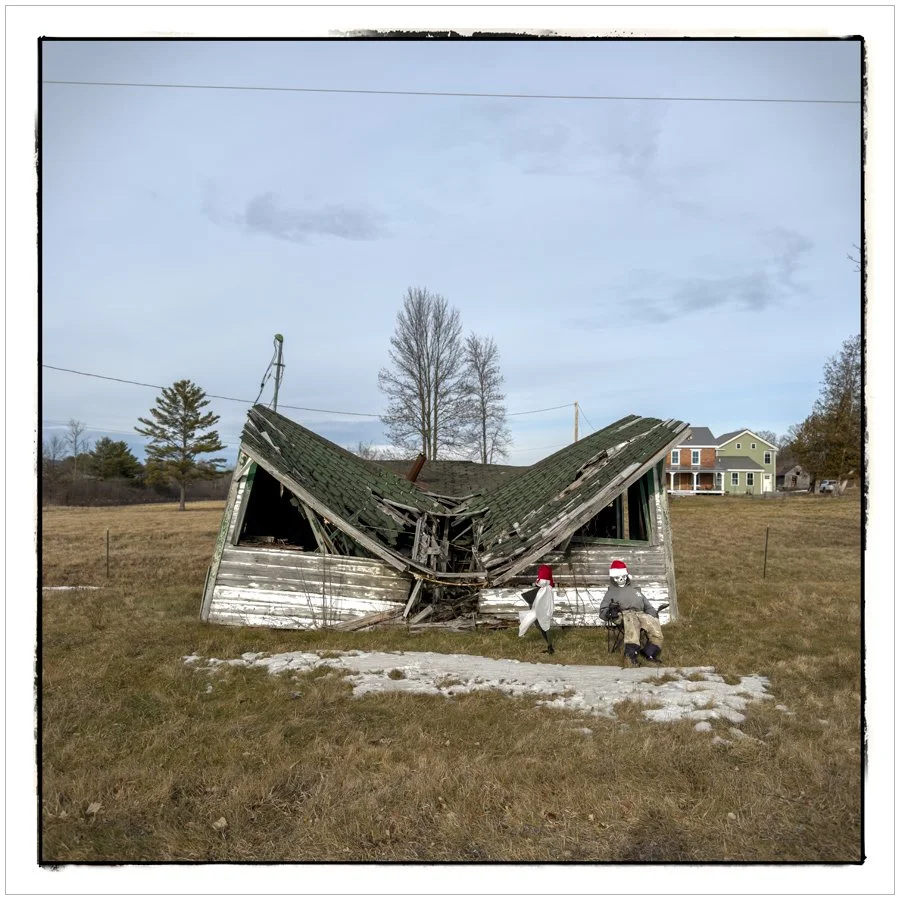
ASIDE another way of thinking of the difference: painters (and the like) can make something out of nothing whereas photographers can only make something out of some thing END ASIDE

Operating under the assumption that the preceding activity of pointing + perceiving has yielded up a satisfactory result–aka: a good picture–I would agree with Cartier-Bresson’s idea that the co-joined act was employed “simultaneously and instantaneously”. Or, in other words, a moment was experienced when the pointer made a decision that it had all come together–a decisive moment, if you will. It is my considered opinion that that moment arrived when the pointer recognized it in the fraction of a second when he/she saw / felt it-through the viewfinder, or on the focusing / viewing screen of their picture making device …. as opposed to mentally checking off items on a list of composition “rules” / guidelines.

All of the above written, the question remains, is it possible to learn how to point and perceive simultaneously and instantaneously? That is, to recognize a fact and the form to express that fact simultaneously and instantaneously? …. all in the cause of creating a pleasing / interesting/ compelling composition pattern / structure across the flat surface of a print.

I have doubts about that but let me quote Edward Weston on the matter of composition:

Good composition is merely the strongest way of seeing.”

…. to which I would add, Some people see better (different?) than others.

# 6758-63 / ~ landscape • common things ~ my involvement with the medium of photography over the past couple days

all photos (embbigenable)

Great light makes great pictures.” ~ Michael Johnston

There is no such thing as “good” or “bad” photographic light. There is just light.” ~ Brooks Jensen

"Light makes photography. Embrace it. Admire it. Love it. But above all, know light. Know it for all you are worth, and you will know the key to photography". ~ George Eastman

SO, OVER THE PAST FEW DAYS I HAVE made some pictures, an endeavor which should not come as news to many. However, in addition to that satisfying activity, I was also very agitated, annoyed, and perhaps even apoplectic in fact.

What set me off, you might ask? All it took was reading the title of a Mike Johnston entry entitled; Great light makes great pictures. I can not explain fully–perhaps psychoanalytic counseling is called for–why I find this so overwhelmingly annoying but let me try to explain; simply stated, that idea is exceedingly stupid, amateur-ish rubbish in so many ways….

…. first and foremost, in order to even begin to understand that postulation one must define what-in-the-hell is “great” light and/or, for that matter, what-in-the-hell is a “great” picture? Seeking the answer to those 2 questions might not ever lead to a consensus so good luck with that quest.

Ignoring that potential pitfall, we can all most likely agree that in order to make a photograph of any kind–great or not so great–requires the availability of light cuz, as we all know, making a photograph is writing with light. So once again, belief wise, I think we can all agree that light is an essential ingredient employed in the making of a photograph.

However, that written, does or can light “make” a photograph?

The dictionary states that the primary meaning of the word make is to form (something) by putting parts together or combining substances. iMo, based on that definition, an actual person is the only maker who can put together all of the many “parts”–ya know, things like vision, technique, gear, subject selection and visual organization, et al–needed to make a photograph. Indeed, light is one of those parts and, in some applications, it can be a very important part but, nevertheless, a “great” picture requires more than just the light, no matter how “great”, in order to be considered to be “great”. In other words, quite literally, light can not make a picture.

That written, the dictionary also iterates other possible meanings of the word make, one of which is to assure the success or fortune of; as in, seeing her makes my day. That meaning of the word could be employed by some viewers of a picture (with “great” light) to state, “The light in that picture is what makes it for me”…..OK, I get that but, if it is only the light that stirs that reaction, then I would suspect that the picture is most likely little more than a sappy, romanticized rendition of something.

All of that written, I categorically reject the idea that great light makes great picture. Sure, sure, some great pictures exhibit the skillful use of great light but, truly great pictures are always about more than the light.

And, please, please, please, don’t get me started regarding serious amateur-made pictures that are “about the light”–with a subset of those that are “about color”–cuz it feels like I have now mellowed out enough to resume regular living.

# 6705-08 / flora • around the house ~ it's a modern life

all photos ~ (embiggenable)

THERE ARE DAYS WHEN I STRUGGLE TO COME up with photography related topics to write about. In large part. that’s cuz during the course of my blogging–decades–I have covered a lot of ground and I try not to repeat topics too frequently and I strive to stay on topic, i.e. the medium of photography and its apparatus.

That written, I do have an interesting life and I could easily write about my sleep habits or all of the fascinating details of the recent decisions I made when purchasing a new car or all about the 3 turbo-powered performance cars I have or there is my golf game and how I have recently re-shafted my forged irons with senior shafts or explaining why I have 4 canoes–2 solo and 2 tandem–and the subtleties of the J-stroke or how about my whiskey collection of rare and very expensive bottled spirits and addressing the question of whether or not my bottle of Pappy Van Winkle 20 Year Old is worth the price or my other hobby of building very complex LEGO sets or … et al …. but, I won’t do it. So instead, it’s on with the show….

Re: “creamy” bokeh: bokeh is the quality and feel of the background/foreground blur and reflected points of light in the out-of-focus, aka: blurry, parts of an image. Bokeh is judged to be “good” when the background blur is soft and “creamy”–smooth, round circles of light and no hard edges–making the blur pleasing to the eye. Bokeh is judged to be “bad” when the circles of light have sharp, aka: well-defined, edges and, dependent upon lens diaphragm blades–rounded blades, good / straight blades, bad–a hexagonal shape.

So, back in the olden days when photographers used those antiquated things called cameras, if one were to be desiring smooth, round out-of-focus circles of light / “creamy” blur, both the number and the shape of a lenses’ diaphragm blades was an all important element in creating that desired result. Making pictures with a fast prime lens, with rounded / blade apertures, set to the lowest value, aka: wide ”open” was the way to go for creating “good” bokeh.

On the other hand, today, in the modern world, one need not be concerned with all that “real” camera crap. Enlightened shooters can just fire up their cell phone’s picture making module / capabilities, set it to the PORTRAIT mode and choose the amount of blur you desire and fire away. And, get this, if you don’t like the result you can increase or decrease the blur–from none at all to max out-of-focus–after the fact during the image processing stage. And, in my experience, there is nary a hard-edge circle to be found and the blur is “creamy” enough to please my eye and sensibilities..

Of course, when employing this technique, you risk incurring the ire of the “real” camera purists who will tell you in no uncertain terms that your blur is “fake”–nothing more than an amateurish, cheap trick / effect cuz, ya know, “real” men use use “real” cameras.

My advice, just smile and move on knowing that “real” people, who enjoy looking at pictures, rarely give a crap about how a picture is made. They just know a good picture when they see it.

# 6701-04 / kitchen life • landscape • common places-things ~ At the risk of hyperbole, couldn't this be regarded as a coup of some sort?

all photos ~ (embiggenable)

I'm not sure why and when artists decided their role was primarily to be enactors of head-hurting philosophical conundrums, but it's never been a good look …. You hardly ever read an artist's descriptive statement of their "practice", now, without being told quite explicitly how this or that gesture, mark, or aesthetic choice "references" this or that important issue, from complex philosophical debates and cutting-edge scientific theories to controversial matters of race, gender, and politics. Why? Because I say so! How? In the way I say! Read the bloody manual statement!” ~ from: idiotic-hat.blogspot.com

THERE IS NO DENYING THAT THE MEDIUM OF photography and its apparatus encompasses a multifaceted means of artistic expression, genre wise. One could postulate that it is all good as long as nothing or no one is harmed in the making of its output. That written, I reserve the right to hold, in relatively deep dislike, both pretty-picture dreck and Academic Lunatic Fringe flapdoodle and green paint pixtures.

Re: the Academic Lunatic Fringe - setting aside setting aside the facts that practitioners thereof profess to be “lens-based artists”–ya know, as opposed to being just “pedestrian” photographers– and that their work product is rarely visually pleasing / interesting to view, what really gets my goat is that they, have for all intents and purposes, virtually hijacked the exhibition worlds of galleries and fine-art museums.

As these practitioners are spewed out of advanced BFA / MFA / Doctorate programs, many rise to positions of gallery directors and heads of photography departments in universities and museums where they rarely exhibit non-conceptual photography. iMo, that practice is most likely dictated by their smug and ingrained prejudice that any “non-educated” idiot can press a shutter release and make a picture. That, plus they all know that a simple-minded photographer can not possibly write a zillion word artist statement loaded with obtuse / nearly incomprehensible artspeak and theory–a “skill” that is deemed absolutely essential to advancing one’s work in the ALF art world.

All of that written, in addition to my outright dislike of ALF work, I am finding it more and more difficult to find fine-art galleries / museums that are exhibiting “traditional” photography. It is my belief that there are some damn good contemporary photographers out there who are making some very good pictures that, consequently, are not seeing the light of day–gallery light, that is. Mores the pity, as they say.

# 6988-91 / kitchen life • flora ~ pictures, not words

All photos ~ (embiggenable)

I always thought good photos were like good jokes. If you have to explain it, it just isn’t that good.” ~ Anonymous

IF IT IS NOT OBVIOUS, LET ME NOTE THAT I RARELY caption or title my photographs, neither on this blog, in my photo books, nor in an exhibition. My primary reason for this omission was, coincidentally, explained in an essay by Lincoln Kirstein in the book Walker Evans ~ American Photographs–a reproduction, page by page / spread by spread–of Evans’ original book as published in 1938:

The scheme of picture titles [left] only the page numbers as minimal distraction to the images …. Without the title’s immediate juxtaposition to the images, the viewer was obliged to fashion his or her own synopsis of the pictures’ content and form. This was another Evans’ impulse to purge all editorial comment from his work. Even his perfunctory titles were bare notations of place and date.”

I have always believed that, cuz the medium of photography is a visual art, words are not necessary. Some even believe that, if words are necessary, a photograph is a failure. That is a bit extreme but I believe a photograph should stand on its own visual merits. In addition, for what it’s worth, I also believe that “cutesy” captions / titles should be eradicated from the face of the earth.

All of the above written, my photo books and exhibition photographs are nevertheless always accompanied by an artist statement. The statements are written as a rather short and sweet synopsis of my picture making intent. Consider the artist statement for my An Adirondack Survey work:

My photographs are visual analogues for the quality of my life, a private view of subject matter found in the commonplace realities of the Adirondacks. An Adirondack Survey, created as an engagement of personal vision rather than as a topographic documentary, illustrates my intent to animate, elucidate, and reveal a sense of beautiful strangeness. That is, not predictability (the opposite of cliche), but rather a kind of shock non-recognition hidden in plain sight within the quotidian landscape of the Adirondacks.

In a very real sense, this statement, with a substitution of the title of any of my bodies of work in place of “An Adirondack Survey”, could be used as the artist statement for any of my bodies of work. I believe that to be true inasmuch as none of my bodies of work, with the exception of my Life Without the APA work, were undertaken to infer / connote any particular social / cultural commentary or intellectual concept; they exist as a simple visual statement from which a viewer may experience any reaction that suits their fancy.

That written, far be it from me to suggest with words what a viewer should experience when viewing my photographs.

6962-78 / common places • common things ~ 5 days of ordinary life

all photos (embiggenable)

Some people are still unaware that reality contains unparalleled beauties. The fantastic and unexpected, the ever-changing and renewing is nowhere so exemplified as in real life itself.” ~ Berenice Abbott

OVER 5 DAYS, LAST WEDS.>SUNDAY, IT RAINED A lot. I took the ferry to Vermont for service for one of our cars and killed time in a Panera Bread. Next day I played golf along Lake Champlain on a Canadian wildfire smokey day. Saturday there was a motorcycle rally in my home town and then it was off to Saratoga Springs for the running of the Belmont Stakes-2nd leg of the race for the Triple Crowd, a fitting appointment to have my irons re-shafted, and to hear our son-in-law’s band. Sunday was a quiet, sunny day at home.

FYI, I have made a few photo books that fall under x-number-of-days titles, i.e. like the title of this entry. Making such a photo book happens when I have had a number of consecutive days of intensive picture making for one reason or another–or, at times, for no reason at all. When I show the books around, viewers are usually rather intrigued by them inasmuch as they are rather fascinated by their interest and attraction to seemingly mundane picture matter.

That written, viewers almost always find a picture or two that really hold their attention and I am often surprised by their selections. I have even has requests a copy of some of the books. The most common comment I hear about their selection(s) is “I never would have thought to take a picture of that” and I must confess that that reaction gives me a great deal of pleasure.

RE: Abbott’s quote …. I would amend it to read that real life provides opportunities to make fantastic, unexpected and beautiful photographs. That cuz, real life does not always present us with unparalleled beauty. And, to my eye and sensibilities, the magic of photography is its ability to transmute the commonplace into something else, i.e. a beautiful–or at least interesting–print.

# 6948-50 / around the house • kitchen life-sink • common places-things ~ a string of pearls

all photos (embiggenable)

Photography takes an instant out of time, altering life by holding it still.” ~ Dorothea Lange

Taking pictures is savoring life intensely every hundredth of a second.” ~ Marc Riboud

We are making photographs to understand what our lives mean to us.” ~ Ralph Hattersley

Your photography is a record of your living, for anyone who really sees.” ~ Paul Strand

BEGINNING WITH THE VERY FIRST PHOTOGRAPH I ever made, I can truthfully write that I never made a photograph–personal as opposed to commercial–that was driven by the desire to convey a meaning. Over time, as I advanced in my pursuit of so-called Fine Art Photography, I pursued my picture making with the belief that photography is a visual art and therefore my picture making objective objective was/is to make photographs that are “interesting”–in some manner or another–to look at / view. Photographs that exhibit what something looks like when photographed in a manner in which I see it.

To be certain, an interesting photograph that incites an emotional reaction / feeling might also, concomitantly, incite word-thoughts which can be expressed verbally. That written, it is a commonly held belief that any emotional and/or word-thought reactions to a photograph are primarily influenced by what the viewer brings to the table– as Sontag wrote … inexhaustible invitations to deduction, speculation, and fantasy”.

If a viewer of my work were to spectulate that my photographs left them with the meaning that beautiful / interesting form can be found in the most mundane of things, I would respond by stating that I am happy you feel that way.

All the above written, I can write that, re: my eye and sensibilities, I am comfortable with the fact that I know the answer to the question, What is a photograph? However, the question to which I do not have the definitive answer is, Why do I make photographs?

That is not to write that I have never thought about the why of it. In fact, I think about it every time I have to write an artist statement to accompany an exhibit or a photo book. Inevitably, such statements will refer to my attraction to the form I see in the quotidian world; a statement which is true as far as it goes and is almost always appropriate. Nevertheless ….

…. at this point in my life, let’s refer to it as late in life, with multiple thousands of photographs in my photo library, I am wrestling with the idea of; a) what do I do with all the photographs, posterity wise? and b) why have I made so many photographs?

Inasmuch as I have made photos nearly everyday over the last 25 years, it is no surprise that I make a lot of photographs. While some might think this activity is some sort of obsessive behavior, I attribute it to the fact that my eye and sensibilities are very sensitive to / aware of the seemingly everywhere form I see that can be photographically extracted from the everyday world. Inasmuch as I live my life with eyes wide open–literally + figuratively–it is almost like a sensory overload. The potential for picture making is nearly inexhaustible so I make a lot of photographs.

WARNING: Psychological mumbo-jumbo to follow.

Let me try to string together the quotes at the top of this entry…

Inasmuch as Photography takes an instant out of time, altering life by holding it still, it stands to reason that Taking pictures is savoring life intensely every hundredth of a second. Ya know, kinda like Evans’ delights of seeing; the defining of observation full and felt.

That written, I must confess that, when making a photograph, I can not write that I am savoring life at the picture-making moment inasmuch as I have never been able to stare at a blade of grass and see the secrets of the universe. That’s cuz, in part, time marches on. Fortunately, one of photography’s magic tricks is that it can “stop” time and with the production of a print that depicts that stoppage, the maker of the photograph–and possibly other viewers–can, indeed, savor the moment over and over.

Does anyone make photographs to understand what our lives mean to us? In all probability, some do–or try to–but, I do not. Nevertheless, it is quite possible that, buried deep in my subconscious, I am making photographs to understand / reassure myself that I am still alive. Not that I am clinging to life by a thread by any measure but, it’s a thought, albeit an unconscious one.

As for Strand’s notion that Your photography is a record of your living, for anyone who really sees, I suppose that, at least in my case, that’s true if he meant the word “living” to be a question of what gives a life a sense purpose, significance, and value; in pursuing knowledge, creating art, or experiencing profound moments of awe and connection.

Which is not to write that making photographs is my raison d'être but it is difficult to imagine what my life would be without it.

# 6920-22/ landscape • around the house • common places-things ~ a bug-ike immersion in the quotidian world

all photos ~ (embiggenable)

WHILE READING AN ESSAY IN THE BOOK, FRED HERZOG • MODERN COLOR, I came across an interesting concept:

In 1962m Manny Farber (film critic) distinguished between what he called “termite art” and “white elephant art.”. Termite artists get on with their art with little regard for posterity or critical affirmation. They are “ornery, wasteful, stubbornly self-involved, doing go for-broke-art and not caring what becomes of it.” They have a “bug-like immersion in a small area without point or aim, and, overall, concentrating on nailing down one moment without glamorizing it, but forgetting this accomplishment as soon as it has been passed: the feeling that all is expendable, that it can be chopped up and flung down in a different arrangement without ruin.” On the other hand, “white elephant art” is made in the self-conscious pursuit of transcendent greatness and in the channels where greatness is conventionally noticed. The white elephant artist is likely to “pin the viewer to the wall and slug him with wet towels of artiness and significance.” We need not choose between these two. Great work can be made by either, and history suggests that this is perhaps more true of photography than any other medium.

After reading this, I believe that I am a termite artist and, btw, the wife thinks that I am ornery.